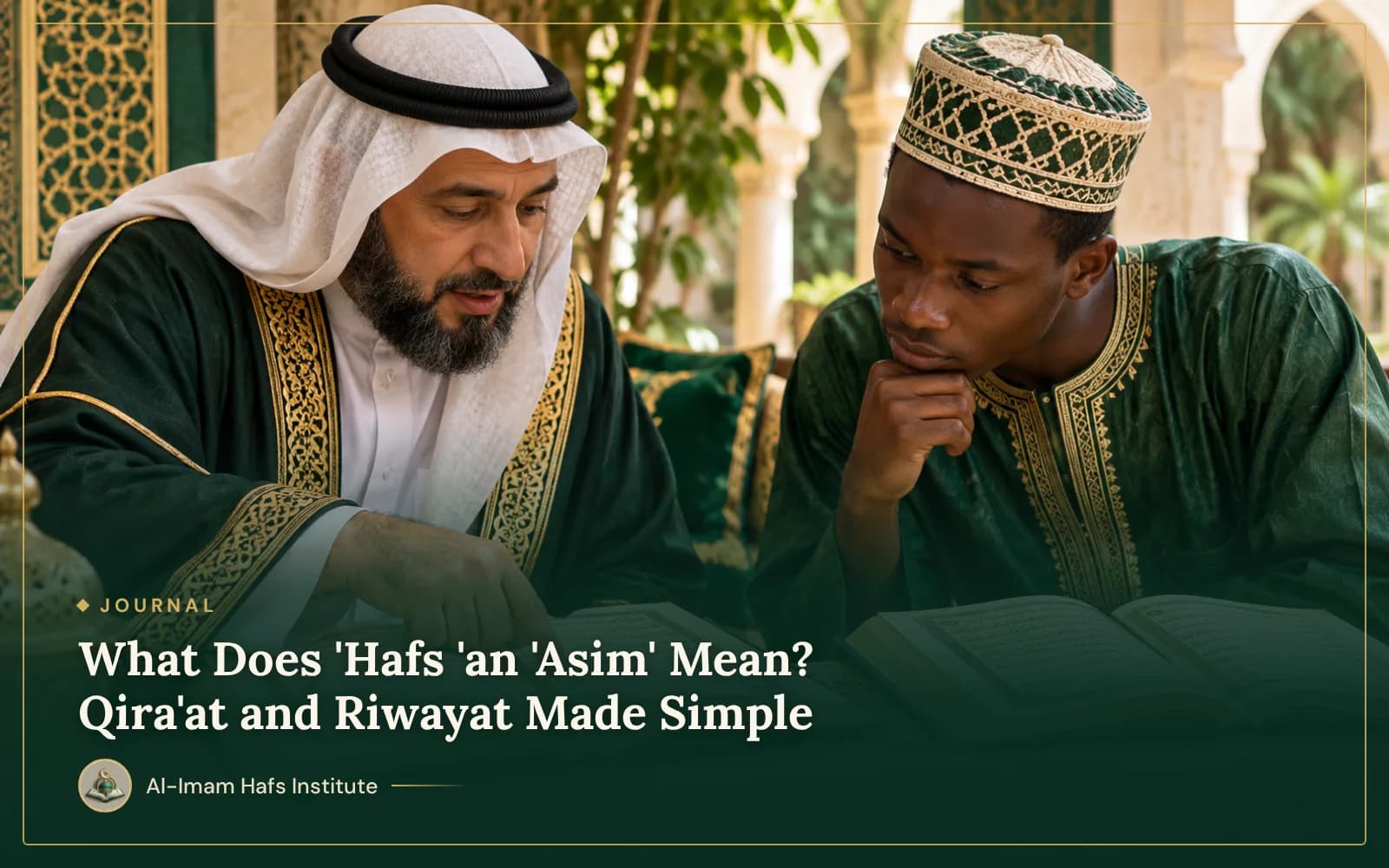
What Does 'Hafs 'an 'Asim' Mean? Qira'at and Riwayat Made Simple
Many learners meet the phrase 'Hafs 'an 'Asim' early on, usually in the closing pages of their copy of the Quran or in the description of a recording. It sounds technical, and people often feel shy to ask what it means. The idea behind it is not difficult. This guide explains it in everyday language, without assuming any background.
The phrase word by word
The Arabic word 'an simply means 'from'. So 'Hafs 'an 'Asim' means 'Hafs, narrating from 'Asim'. It names two people: 'Asim, an imam of recitation who lived in Kufa, and Hafs, his student, who passed on his teacher's way of reciting.
When a printed Quran says it follows this narration, it is telling you how the words are to be pronounced and how the text has been vowelled and marked.
What is a qira'ah?
A qira'ah (plural: qira'at) is a complete way of reciting the Quran that is attributed to one of the great imams of recitation. The imam is called a qari, a reciter.
These imams did not compose their readings. Each one learned the Quran from teachers whose chains reach back to the Prophet, peace and blessings be upon him, and each became so well known for precision that people in his city gathered to learn from him. The reading was then named after him, in the same way that a route may be named after the guide who knows it best.
The readings accepted by the scholars are ten. Seven of them became especially famous after the scholar Ibn Mujahid gathered them in a well-known book, and three more complete the ten. The imams lived in the main centres of learning: Madinah, Makkah, Kufa, Basra and Damascus.
What is a riwayah?
A riwayah (plural: riwayat) is a narration of an imam's reading through one of his students, or through a student of his students. The narrator is called a rawi.
For each imam, the scholars selected two narrators who became the standard route to his reading. A few familiar examples:
'Asim of Kufa: narrated by Hafs and Shu'bah.
Nafi' of Madinah: narrated by Qalun and Warsh.
Abu 'Amr of Basra: narrated by al-Duri and al-Susi.
Ibn Kathir of Makkah: narrated by al-Bazzi and Qunbul.
So 'Hafs 'an 'Asim' and 'Warsh 'an Nafi'' are both riwayat. The first is the most widespread in the world today; the second is common across much of North and West Africa.
What actually differs between them
This is the question most people really want answered. The readings do not differ in the message of the Quran, in its surahs or in its rulings of faith. The differences are in details of pronunciation and, in a limited number of places, in the form of a word. All of them fit the written text of the Quran as it was copied in the time of the companions.
Some examples make this clear:
In Surah Al-Fatihah 1:4, Hafs reads maliki with a long a, 'Master of the Day of Judgement', while several other readings have a short a. Both forms are transmitted and both meanings are true of Allah.
Hafs pronounces the last word of Surah Al-Ikhlas 112:4 as kufuwan, with a w sound, where most other narrations pronounce a hamzah.
In the narration of Warsh, a hamzah at the start of a word is often dropped and its vowel moved onto the letter before it. Hafs does not do this.
Some narrations tilt the vowel a towards e in many words, which is called imalah. Hafs does so in only one word in the whole Quran, in Surah Hud 11:41.
A listener who knows one narration will recognise almost every word of another. The differences are real and carefully recorded, but they are fine details inside one text.
Why all of them are authentic
The scholars did not accept a reading simply because someone recited it. They set three well-known conditions:
It must be transmitted through sound, widely attested chains back to the Prophet, peace and blessings be upon him.
It must agree with the Arabic language.
It must agree with the written form of the copies of the Quran prepared in the time of the caliph 'Uthman, may Allah be pleased with him.
A reading that meets these conditions is part of the Quran as it was taught. For this reason no narration is 'more correct' than another. Choosing one is a matter of what is taught in your region and by your teacher.
Do I need to learn more than one?
No. The great majority of Muslims learn a single narration and recite it all their lives. Studying several is a specialised field, usually begun after a student has memorised the Quran and mastered tajweed in one narration.
For a beginner, mixing narrations causes confusion. The sound advice is to choose one, stay with it, and learn it properly from a teacher. If your copy of the Quran follows Hafs and the recordings you hear follow Hafs, your learning will be consistent from the start.
A simple way to remember it
Qira'ah: the reading of an imam, for example 'Asim.
Riwayah: the narration of that reading by a student, for example Hafs.
Hafs 'an 'Asim: the recitation of Imam 'Asim as passed on by Hafs.
Learn it with a teacher
Al-Imam Hafs Institute teaches the narration of Hafs from 'Asim in live online lessons, one-to-one or in small groups, for children and adults. Our qualified teachers listen to your recitation and correct it patiently, step by step. You are welcome to book a free trial lesson at a time that suits you and see how it works.