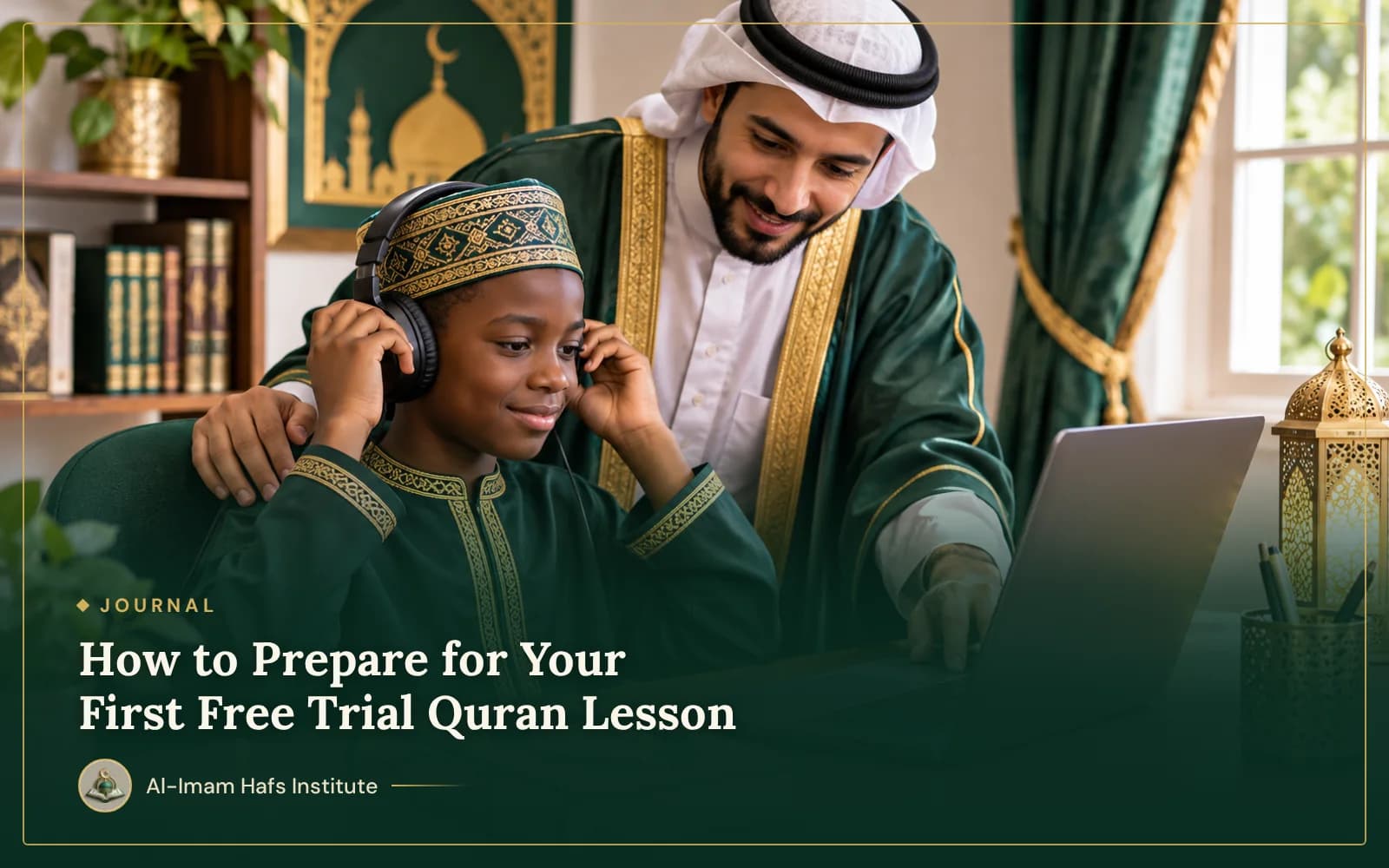
How to Prepare for Your First Free Trial Quran Lesson
A first lesson with a new teacher can bring a little nervousness, particularly for an adult returning to the Quran after many years, or for a parent arranging lessons for a child. That is entirely natural, and a small amount of preparation removes most of it.
This guide covers what to arrange beforehand, what to think about, what to ask, and what usually follows. None of it takes long, and all of it helps the teacher to help you.
What the trial lesson is for
A trial lesson is not an examination and nobody is graded. It has two purposes. The teacher needs to hear where you are, so that teaching starts from the right point. You need to see how the teacher explains and corrects, so that you can judge whether the lessons suit you or your child.
Keeping this in mind takes the pressure away. Mistakes in a trial lesson are useful, because they show the teacher exactly what to work on.
Your device and connection
Recitation is taught by ear, so clear sound matters more than anything else on the technical side.
Use a laptop, tablet or computer where possible. A larger screen makes it easier to follow the text the teacher shows.
Wear headphones or earphones with a microphone, so that the teacher can hear the fine detail of your pronunciation.
Check your camera, microphone and internet connection a little before the lesson, not at the moment it begins.
Charge the device or keep it plugged in, and close other applications that may send notifications.
Follow the joining instructions you are given, and be ready a few minutes early.
A quiet place and what to have beside you
Choose a room where you can recite aloud without embarrassment and without interruption. Let the household know that you will be in a lesson.
A mushaf, or the learning book you have been using, if any.
A notebook and pen for the points the teacher corrects.
A glass of water, as reciting aloud dries the throat.
For a child: a parent nearby for the first lesson, a table at the right height, and no toys or screens within reach.
It is good practice to make wudu and to sit with composure. The setting is online, but the lesson is still a sitting with the Book of Allah.
Know your goal
Teachers plan differently for different aims, so decide what you most want before the lesson. One clear sentence is enough.
To learn to read the Quran from the beginning.
To correct my recitation and learn tajweed properly.
To memorise, or to revive memorisation I have lost.
To understand what I recite through Arabic.
To give my child a sound foundation and a love of the Quran.
If you have several aims, say which comes first. Mention too how many days a week you can realistically give, since a modest plan that is kept is worth more than a full one that is abandoned.
Be honest about your level
There is no need to appear better than you are, and no reason to feel ashamed of where you start. Tell the teacher plainly:
Whether you can read Arabic script, and how fluently.
What you have studied before, with whom, and for how long.
How much you have memorised, and how firmly you still hold it.
Which sounds or rules you know you find difficult.
For a child: their age, how long they can concentrate, and anything that helps them to learn.
The teacher will usually ask you to read a short passage. Recite as you normally would. A natural recitation gives a truer picture than a careful performance.
Questions to ask the teacher
From what you heard, where should I begin?
What are my two or three most important mistakes to correct?
How would a typical lesson be divided between new material and revision?
What should I practise between lessons, and for how long each day?
Would one-to-one lessons or a small group suit me better?
How will my progress, or my child's, be followed over time?
Write the answers down. They form the outline of your first study plan.
What happens afterwards
At the end of the lesson the teacher will normally share an impression of your level and a suggested starting point. You are then free to think it over. A trial lesson carries no obligation to continue.
If you decide to go on, the usual next steps are to choose between one-to-one and small-group lessons and to agree days and times that fit your routine. Whatever you decide, try to act on the corrections you received while they are still fresh. Even one corrected letter is a real gain.
Book your free trial lesson
Al-Imam Hafs Institute teaches Quran recitation, memorisation, tajweed, Arabic and Islamic studies in live online lessons, one-to-one or in small groups, with qualified teachers for children and adults, at flexible times. When you are ready, book a free trial lesson, bring your goal and your questions, and take the first step with a teacher beside you.