
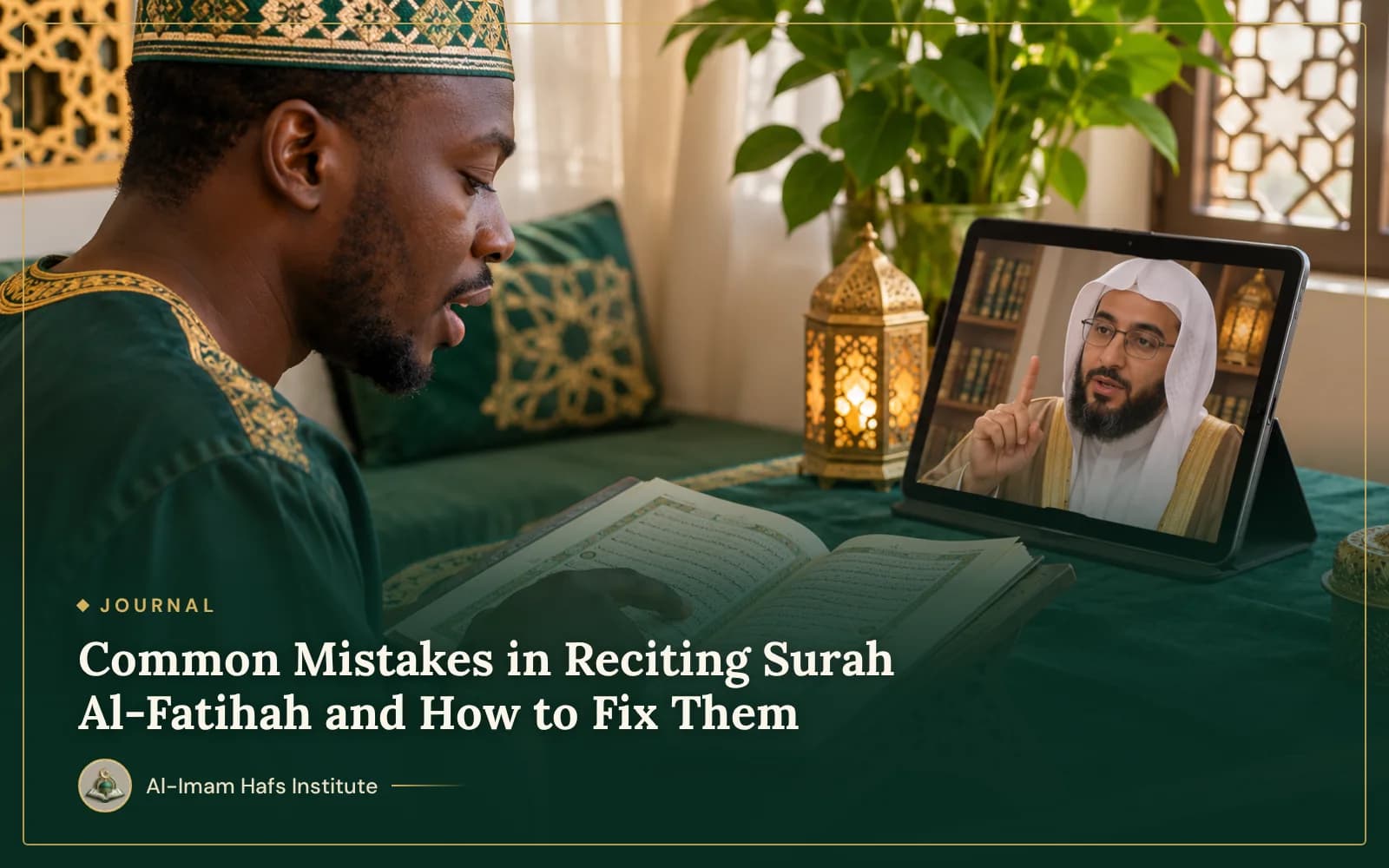
Common Mistakes in Reciting Surah Al-Fatihah and How to Fix Them
Surah Al-Fatihah is the first surah most Muslims learn and the one they recite most often, in every unit of every prayer. Because it is learned so early, often in childhood and often without a teacher, small mistakes can settle in and go unnoticed for years. The good news is that the surah is short, the common mistakes are well known, and each of them can be corrected with a little guided practice.
Two kinds of mistake
Scholars of tajweed describe two kinds of error. A clear mistake changes a letter or a vowel, and may change the meaning. A hidden mistake leaves the word intact but falls short in the finer rules, such as the length of a vowel or the nasal sound.
A learner should deal with the clear mistakes first. Almost all of those found in Al-Fatihah belong to four groups: similar letters, the shaddah, short and long vowels, and the final vowels of words.
Confusing the two h sounds
Arabic has two letters that English speakers hear as h. One is the light ha (ه), from the deepest part of the throat, like the h in 'house'. The other is the stronger Ha (ح), from the middle of the throat, with a clear breathy friction and no equivalent in English.
Al-hamdu, ar-rahman, ar-rahim: all three have the strong Ha (ح). Reciting them with the light ha is a very common error.
Ihdina: this word has the light ha (ه). Some learners, having worked hard on the strong letter, use it here by mistake.
In the same way, the letter 'ayn (ع) in al-'alamin, na'budu, nasta'in and an'amta is often replaced with a simple glottal stop. 'Ayn comes from the middle of the throat and has a full, continuous sound.
The heavy letters: sad, ta, qaf and dad
Several letters in the surah are heavy, meaning the back of the tongue rises and the sound fills the mouth. When they are made light, they turn into other letters.
As-sirat: the first letter is sad (ص), not sin (س), and the last is the heavy ta (ط), not the light ta (ت).
Al-mustaqim: the letter is qaf (ق), from the very back of the tongue, not kaf (ك).
Al-maghdubi and ad-dallin: both contain dad (ض), the letter for which Arabic is famous. It is produced from the side of the tongue pressing against the upper back teeth. It should not sound like an ordinary d, nor like dha (ظ), nor like z.
A related mistake occurs in alladhina, where the letter dhal (ذ) is pronounced as z or d. For dhal, the tip of the tongue touches the edges of the upper front teeth, as in the English word 'this'.
Dropping the shaddah in iyyaka
A shaddah means the letter is doubled: you rest on it and then release it. In iyyaka na'budu wa iyyaka nasta'in, the letter ya carries a shaddah in both places. Reciting it with a single ya is one of the mistakes teachers warn about most, because the word is then no longer the word that was revealed.
The same care applies to every shaddah in the surah, including those in rabbi, ar-rahman, ad-din, as-sirat, alladhina and ad-dallin. A helpful exercise is to pause very slightly on the doubled letter until the habit is formed.
Lengthening where there is no madd
A short vowel is one beat. A natural long vowel is two. Stretching a short vowel adds a letter that is not in the text.
Saying na'buduu with a long final vowel, where the dal has only a short dammah.
Stretching the last vowel of iyyaka so that it sounds like 'iyyakaa'.
Lengthening the kasrah in rabbi or in maliki at the end of the word.
The opposite mistake is cutting a long vowel short, for example in maliki, which in the narration of Hafs has a long a after the mim, or in ihdina and as-sirat.
One long vowel needs special attention. In wa la-ddallin, the alif after the dad is followed by a doubled lam, so it is held for six beats. Many people hurry past it.
Changing the final vowel
The short vowel at the end of a word often carries its grammar, so changing it can change who is doing what. The best-known example is an'amta, 'You have bestowed favour', where the ta has a fathah. Reciting it with a dammah turns the meaning to 'I have bestowed', which is a serious error.
Learners should also take care to recite iyyaka with a fathah on the kaf, and to pronounce the kasrah clearly in maliki yawmi d-din.
How a teacher corrects these mistakes
People rarely hear their own errors, which is why Al-Fatihah is best checked by someone else. A careful teacher usually works like this:
Listens to the whole surah once without interrupting, and notes what needs attention.
Chooses the most important mistake and works on that one first.
Shows where the letter is produced and demonstrates it alone, with a sukun.
Contrasts it with the letter it was confused with, so the student can hear and feel the difference.
Returns the letter to its word, then the word to its verse, slowly.
Asks the student to repeat until it is correct several times in a row, and checks it again at the next lesson.
Working on one correction at a time prevents the learner from feeling overwhelmed, and it means each improvement holds.
Have your Fatihah checked in a free trial lesson
A single session with a teacher is often enough to discover which of these points apply to you. At Al-Imam Hafs Institute, qualified teachers listen and correct in live online lessons, one-to-one or in small groups, for children and adults, at flexible times. You are welcome to book a free trial lesson and begin with the surah you recite every day.